The Morning After the Hurricane, Every Phone in the Valley Still Worked. None of Them Could Say Anything.
When Helene hit western North Carolina, three out of four cell sites went dark and whole towns vanished from the map for weeks. The network that came back first wasn't built by a carrier. It was built by neighbors, with $20 radios and sunlight. Here's how to build yours before you need it.
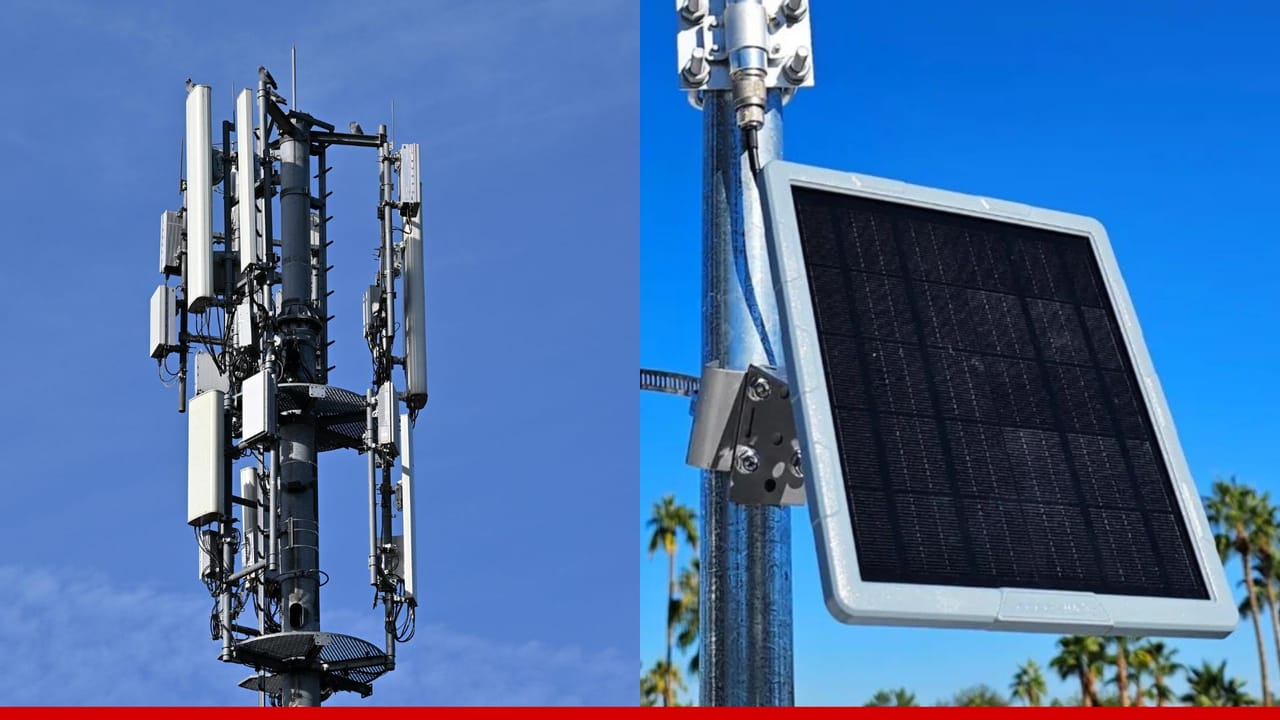
On the morning of September 27, 2024, people across western North Carolina woke up, picked up their phones, and did the thing everyone does. They checked on the people they love.
The phones were fine. Charged, dry, fully functional. And completely mute. No bars in Swannanoa. No bars in Chimney Rock. No bars across most of Buncombe County, where the city of Asheville sits. Hurricane Helene had come inland as a tropical storm and dropped historic rainfall onto mountains that funnel water like plumbing, and by sunrise the region had lost power, water, roads, and, almost as completely, the ability to tell anyone anything.
What happened next is the part that stays with you. People started driving to the tops of hills and parking there, holding phones out of windows, hunting for one bar. Families wrote names and "WE ARE OK" on whiteboards and plywood and propped them at the ends of driveways for anyone passing. Fire stations became message boards. In some towns the only functioning information system for days was literally a human being with a clipboard standing in a parking lot.
Over 120 people were dead in the early counts. Hundreds were unaccounted for, and here's the thing about that phrase: a huge share of "unaccounted for" people after Helene weren't missing at all. They were sitting in their own homes, fine, with no way to say so. The gap between safe and known to be safe was the size of the communications blackout, and for tens of thousands of families that gap lasted one week, two weeks, in the hardest valleys longer.
The phones never broke. The network behind them did. And if you've read the $20 radio piece, you already know where this is going, because the technology that filled that gap in the mountains is the same one this site spends most of its time writing about. This post is the specific, practical version of that story: what actually failed after Helene and why it always fails the same way, what quietly worked, and the exact weekend project that puts your own street on the working side of that line before this hurricane season, the one that officially started June 1 and already produced its first named storm, gets any further along.
 Flaresat Team
Three Out of Four
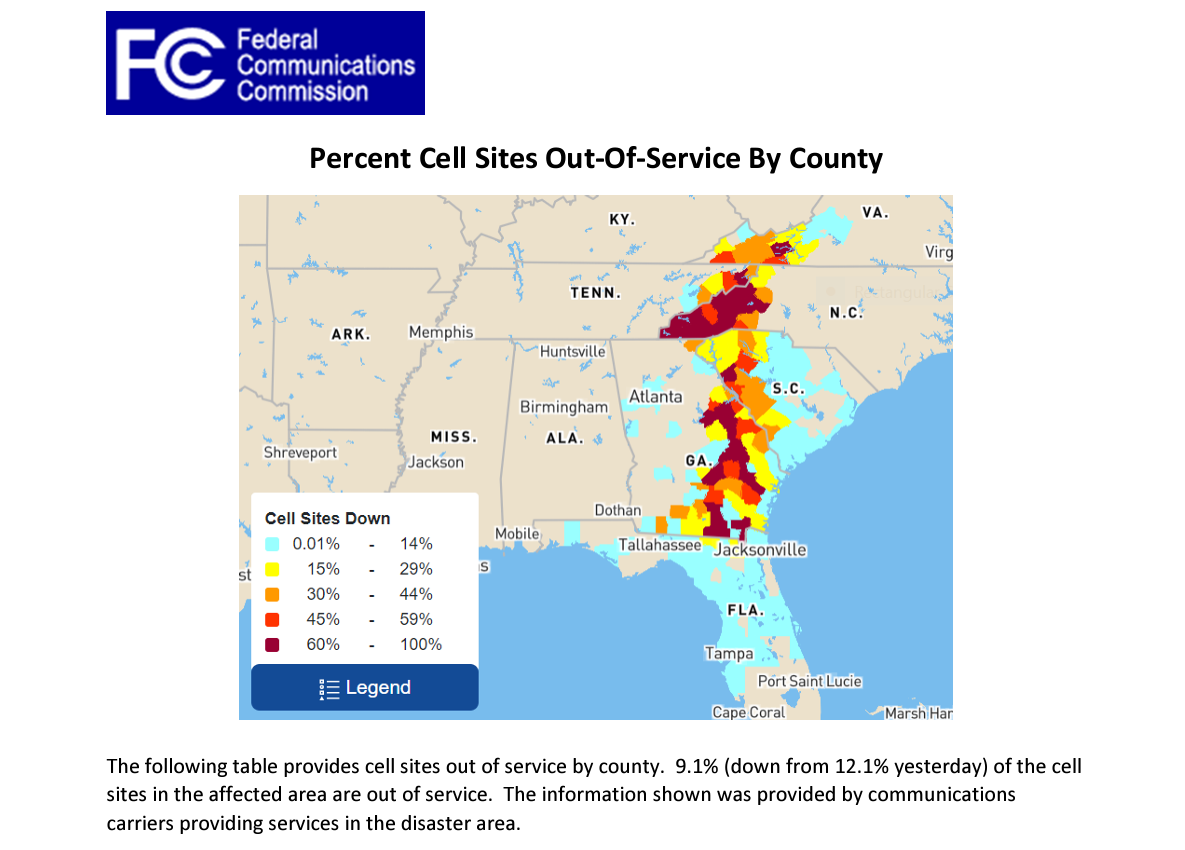
The FCC runs something called the Disaster Information Reporting System. When a storm is coming, carriers in the affected counties have to report, every day, how many of their cell sites are up. The reports are public PDFs, dry as toast, and after Helene they read like a slow-motion collapse.
Two days after landfall, 74.3 percent of the cell sites in the impacted areas of western North Carolina were out of service. Not degraded. Out. In Avery, Mitchell, and Yancey counties, fewer than one in ten sites was fully functioning. Across the whole multi-state disaster area, more than one in five sites was dark, and the number was still rising four days after the storm as tower backup batteries died faster than anyone could reach them.
That last detail is the one worth understanding, because it explains why this keeps happening and why it will happen again somewhere this year. A cell tower is not a self-sufficient thing. It's the visible tip of a long, fragile chain. It needs grid power, and when the grid fails it falls back on batteries that are typically sized for four to eight hours, after which it needs a generator, which needs fuel, which needs a truck, which needs a road. After Helene the roads themselves were gone, four hundred plus of them closed, bridges washed out, so the fuel trucks sat and the towers went dark one by one like a string of lights being unscrewed.
And even a powered tower is useless without its backhaul, the fiber line that connects it to the rest of the world. Carriers reported heavy fiber cuts across the region. A cell tower with electricity and no fiber is a very tall monument. Your phone will happily show bars from it. Nothing you send goes anywhere.
The restoration effort was genuinely heroic and genuinely slow. Carriers rolled in cell sites on trucks and flew drone base stations. FEMA distributed Starlink terminals to county emergency operations centers. The FCC gave SpaceX and T-Mobile emergency authority to push satellite text alerts to ordinary phones, one of the first big real-world tests of direct-to-cell. All of it helped, and all of it took days to weeks, and nearly three weeks after landfall the FCC was still logging seven percent of sites down in North Carolina and Tennessee because crews physically could not reach them through the terrain.
Here's the sentence that should be printed on the box of every phone sold in a hurricane state: the network your phone depends on is a centralized system, and centralized systems fail centrally. One flooded switching center, one cut fiber trunk, one impossible fuel logistics problem, and coverage doesn't degrade politely around the damage. It disappears across whole counties at once, precisely at the moment when every person in those counties needs it most and would gladly settle for the ability to move twenty words of text.
Twenty words. We're at the house, everyone's fine, water's out, tell Mom. That's the actual communication need of a family in a disaster, ninety percent of the time. It is a laughably small amount of data. And the infrastructure we all rely on could not move it across a valley for two weeks.
What Was Moving Messages While the Towers Were Dark
Amateur radio operators were the first working link out of many of those valleys, the way they have been in every American disaster for a century, passing health-and-welfare traffic out of the mountains by voice and by packet. Ham radio is a genuinely great disaster tool and deserves every bit of its reputation. It also has a structural ceiling: it requires a licensed, trained operator on at least one end of every conversation. It moves messages for a community, one at a time, through a human bottleneck. It cannot give the community itself a network, something where every family is a participant rather than a supplicant standing in line at the fire station.
The thing that could, did, in scattered, improvised, mostly undocumented ways. Volunteers and locals with LoRa mesh gear, the same $20-to-$90 Meshtastic hardware this site reviews, started standing up nodes on rooftops in North Carolina and Tennessee, and encrypted text messages started hopping across terrain that had defeated every fuel truck in the region. No tower, no fiber, no license, no grid. A message would leave a phone in a dark valley, jump radio-to-radio from node to node, and land on a phone that could see the outside world.
It worked well enough that it changed minds in official places. Down in Jefferson County, Florida, the local Community Emergency Response Team watched what happened in the Helene zone and then went to their city council with a plan that sounds like a hobbyist's daydream and is actually now grant-funded disaster infrastructure: small solar-powered Meshtastic nodes, about $100 each, attached by drone to the tops of water towers across the county, so that when the next storm takes the cell network down, the mesh is already hanging there in the sky, charged, waiting. The program manager's pitch to the council leaned directly on the fact that the same system had already proven itself in North Carolina and Tennessee after Helene wiped out first responder communications.
Sit with the economics of that for a second. A single commercial cell site represents hundreds of thousands of dollars and a permanent umbilical of power and fiber. The thing the county is bolting to water towers costs a hundred dollars and its umbilical is the sun.
And if you want proof the approach scales past a county, the security community accidentally provided it. At DEF CON in Las Vegas, attendees stood up a Meshtastic network of more than 2,000 nodes across the city, the largest known mesh ever assembled, moving thousands of messages with zero infrastructure. They built it mostly to send each other memes. The same architecture, pointed at a disaster instead of a joke, is a county-wide emergency network that no storm can decapitate, because it has no head.
"But They Said This Season Would Be Quiet"
They did, and it's worth being straight about it rather than doing the preparedness blog thing of pretending every season is the apocalypse. NOAA's outlook for 2026 calls for a below-normal Atlantic season, eight to fourteen named storms, the agency's first below-normal forecast in more than a decade, mostly because an El Niño is expected to shear storms apart before they organize. Tropical Storm Arthur formed off the Texas coast in mid-June, fizzled, and that's been it so far.
So why is this post running now? Three honest reasons.
The first came from NOAA's own administrator, in the same breath as the calm forecast: it only takes one. Hurricane Andrew, the storm that flattened South Florida in 1992 and stood for decades as the most damaging in US history, arrived in a season that was forecast below normal and mostly was below normal. Andrew didn't care about the seasonal average, and neither did the people whose houses it removed. A quiet season is a statistical statement about a basin. Your town doesn't experience the basin. It experiences whatever crosses your county line, once.
The second is how fast "nothing" becomes "catastrophe" now. Hurricane Melissa, at the tail end of last season, went from an unremarkable system to a Category 5 in 39 hours. That's the new pattern, rapid intensification fueled by abnormally warm water, and it means the comfortable old rhythm where you watched a storm crawl across the Atlantic for a week and did your preparing on Wednesday is increasingly a memory. Thirty-nine hours is not enough time to order radios, learn firmware, and organize your street. It's barely enough time to buy plywood.
The third is that this was never really a hurricane post wearing a hurricane hat. Strip the storm out and substitute the thing your own region does: the wildfire that burns the fiber runs, the ice storm that snaps poles across three counties, the earthquake, the substation failure, the plain, boring, increasingly common multi-day grid outage. The failure chain is identical every single time, power dies, tower batteries buy you an afternoon, fuel logistics lose the race, and an entire region simultaneously rediscovers that five bars was always a rental. The mesh answer is also identical every time, which is exactly why it's worth building in July regardless of what the tropics do.
The Anatomy of a Street That Can't Be Silenced
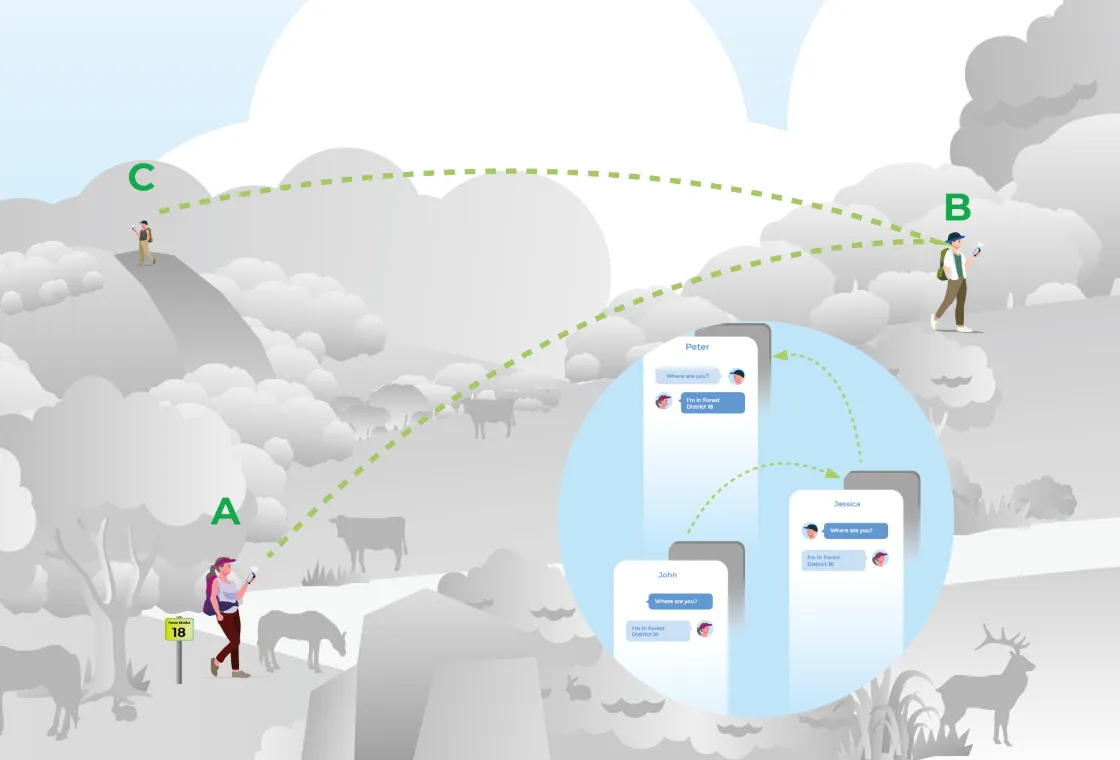
Here's what an actual neighborhood mesh looks like, not the theory, the parts list and the reasons, and none of it requires you to be an electronics person. Every device below gets its firmware flashed in a web browser in about five minutes, and the complete getting started guide walks through every step with screenshots. Think of the network as three layers doing three different jobs.
The first layer is one always-on node, mounted high, on one volunteer roof. This is the keystone. Individual handheld radios talking at ground level, through houses and trees, will reach each other across a few streets. Put one node two stories up with clear air around it and everything changes, because LoRa range lives and dies on elevation. Radio waves at these frequencies travel by line of sight, and every meter of height opens up geometry that no amount of transmit power can buy from the ground. The difference between a node on a windowsill and the same node at the roof peak is routinely the difference between covering your cul-de-sac and covering your zip code.
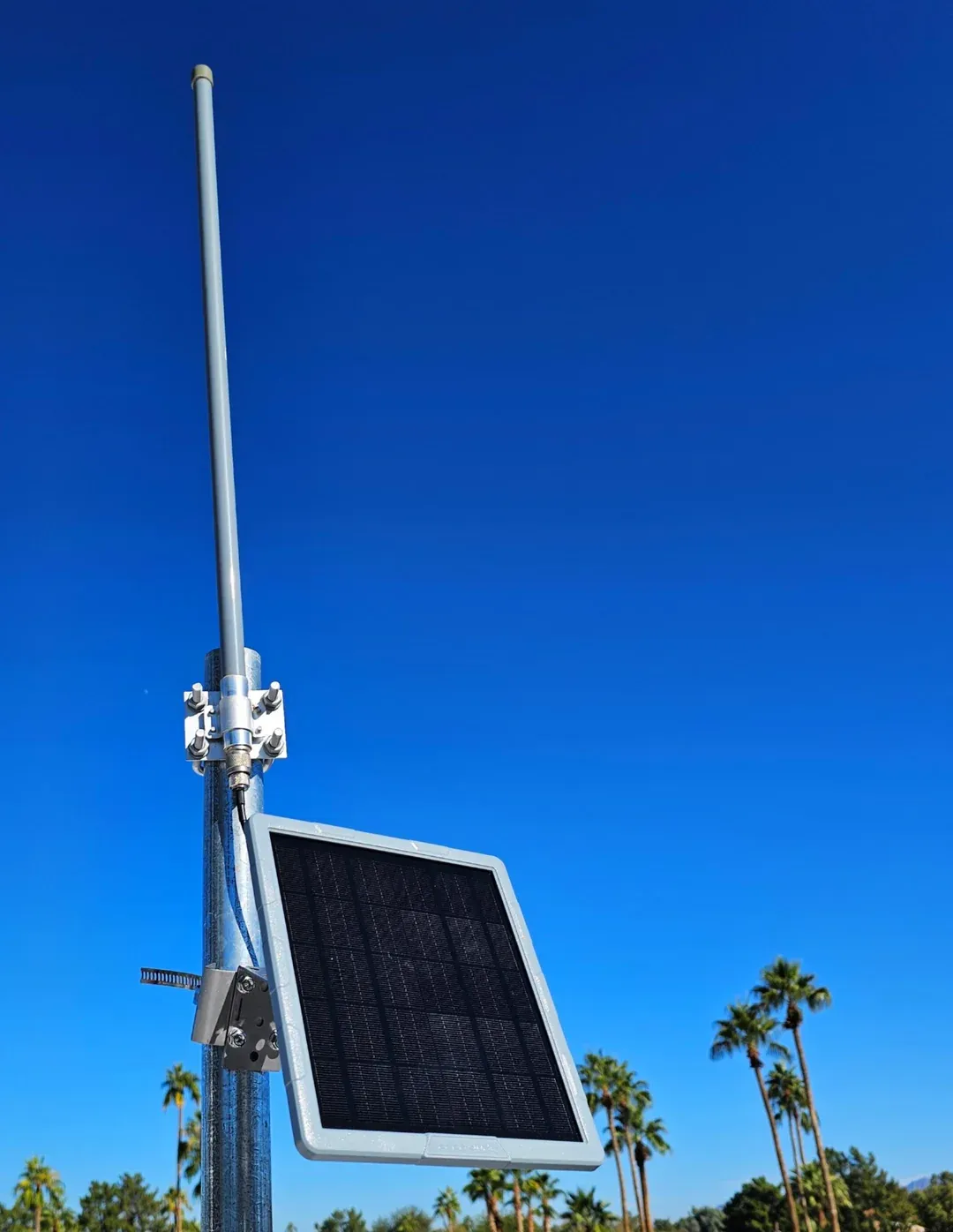
The device we recommend for this job, after running one ourselves and reviewing it at length, is the SenseCAP Solar Node P1 Pro: a weatherproof, pole-mountable unit with a 13,400 mAh battery and a 5W solar panel built into the housing, under $90. In our indoor test, with zero sunlight, it ran nine consecutive days on battery alone. Outdoors, in actual weather, the math simply never runs out; a few hours of even overcast sky replaces a day of operation. Configure it in the ROUTER role so it dedicates itself to relaying, mount it high, and then do the most important thing: forget it exists. Its entire purpose is to be the node that is still awake at 3 a.m. during the storm, quietly passing everyone else's messages, while every piece of infrastructure around it that needs the grid goes dark. During Helene, the towers needed convoys. This thing needs the sun to come up eventually.
One rooftop node covers a typical suburban neighborhood. If your area is bigger or hillier, two or three of them on the high spots, a kilometer or two apart, stitch a whole small town together, and this is where the project gets social in a good way, because "whose roof gets the node" is exactly the kind of question that turns a group chat of neighbors into an actual network of them.
The second layer is a radio in every participating household. These are the devices people actually hold, and the good news is that this category matured beautifully in the past two years. The RAK WisMesh Tag is the one we keep coming back to for this exact use case: credit-card sized, IP66 water resistance, built-in GPS, five to six days of battery per charge, $39.90. It's the "clip it to the go-bag in March, it's still alive in September" option. The Seeed Wio Tracker L1 Pro is the step up for anyone who wants a screen: a complete self-contained handheld with GPS and solar top-up for $43. And for households where budget is the whole conversation, a bare $20 board flashed in the browser does the same fundamental job, and building one is honestly half the fun of this hobby.
Each radio pairs to its owner's phone over Bluetooth, and this is the mental model that makes the whole thing click for newcomers: the phone is just the keyboard and screen. It needs no service, no SIM, no Wi-Fi, nothing. The radio does the communicating, the messages are AES-encrypted with a channel key that only your group holds, and with GPS aboard, every member appears as a live dot on every other member's map, updating automatically every few minutes. In a disaster that last feature quietly outranks the messaging. Where is everyone is the question that eats families alive in a blackout, and a mesh with position broadcasting answers it continuously, without anyone having to ask.
The third layer is the bridge to the outside world, and it costs nothing. Here's the pattern from every real disaster, Helene very much included: connectivity never dies evenly. Your valley is black, but a gas station two ridges over has one working carrier, or one house on the hill kept its Starlink, or, most commonly of all, the people who most desperately need to know you're okay are five hundred miles away with perfect internet and no way to reach you.
Bridging a radio mesh to the internet used to be the province of people who enjoy running their own MQTT broker, which is to say, a hobby project, not a family plan. Flaresat's Relay Bridge collapsed it to one tap, and this is the piece that turns a neighborhood mesh from "we can talk to each other" into "we're back on the map." Any one person whose phone finds any internet at all, one bar of LTE on a hilltop, a borrowed Starlink, a coffee shop in the next town, links the radio group to a cloud group and confirms. From that moment everything flows both ways in real time: every message and every live position from the mesh appears for the cloud side, and the aunt in Ohio watching a browser tab sees the whole family as moving dots on a map, drops a pin, shelter open at the church on Route 9, and it lands on every radio in the valley within seconds. The app is free on iOS, Android, and the web, and it speaks both Meshtastic and MeshCore, so it doesn't care which side of the great firmware debate your group lands on.
That capability, a live common picture shared between people who have connectivity and people who have none, is what county emergency managers spend real budgets trying to approximate. It now runs on a $40 radio and a free app, which is the kind of sentence that would have gotten you laughed out of an emergency management conference five years ago.
The Weekend
Add it up before we talk about the doing of it. One P1 Pro on a roof, call it $90. A WisMesh Tag or Wio Tracker for each of five households, call it $200. The firmware is open source, the apps are free, the spectrum is unlicensed, and the monthly bill does not exist and never will. Under three hundred dollars, total, forever, for an entire street. A single mid-size generator costs more than that and keeps exactly one refrigerator cold. A single Garmin inReach plus two years of a mid-tier plan costs more than that and connects exactly one person.
The build itself is honestly the easy part, and it fits in a weekend without crowding it. Saturday morning, gear arrives or boards get flashed, five minutes each in a browser tab. Saturday afternoon, you create a private encrypted channel and share it around, which in practice means neighbors pointing their phones at a QR code on your kitchen table, and there is something quietly wonderful about watching a retiree who describes herself as "not a tech person" join a sovereign encrypted radio network in four seconds because it looked exactly like scanning a menu. Sunday morning, the solar node goes up high, and you walk the neighborhood with a handheld confirming every house can hear it. Sunday evening, you run the one drill that matters: someone's phone on airplane mode sends a message through the mesh, someone else's phone bridges it to the cloud, the far-away relative sees it and drops a pin, and the pin arrives back on the radios. Ten minutes, start to finish.
Then do the unglamorous thing that separates preparedness from gear collecting: print a one-page sheet, channel name, node names, "if the towers die, texts still work, open this app, here's the picture of the icon", and tape it inside a kitchen cabinet in every participating house. In the actual event, with the power out and the wind up, nobody is going to remember a conversation from July. They will absolutely read a piece of paper taped where the coffee mugs live. The calm instructions you write on a boring Sunday are worth more than any single piece of hardware on this page, because the network you built is only as useful as the neighbor who remembers it exists.
And here's the part that makes this stick where every other preparedness purchase gathers dust: the network is not a sealed emergency device waiting grimly in a closet. It's a toy the other 364 days. You will track the family dog-walker on the live map, you will pipe node telemetry into Grafana dashboards for no defensible reason, you will bolt weather sensors to things, you will have opinions about antennas. That's not a bug in the plan. Gear that gets played with is gear that is charged, understood, and functional on the day. The disaster capability rides along for free on top of a genuinely fun hobby, and that is the only kind of preparedness that survives contact with real life.
The Bigger Picture
There's a line in the congressional research summary of the Helene communications failure that reads, in the flat language of such documents, like an epitaph for a whole way of thinking: residents and local officials "faulted public-private preparation efforts." Translated from Washington: the system everyone assumed would be there was not there, and the people it left behind noticed.
It will be partially fixed, and then it will happen again, because the fix is always more of the same architecture: more backup batteries, more fuel contracts, more portable towers staged closer, more satellite stopgaps. All of it worth doing. All of it, still, a centralized system whose failure mode is regional and whose recovery is measured in convoy-days.
The mesh fails in the opposite direction, which is to say it barely fails at all. There is no switching center to flood, no trunk line to cut, no headquarters, no top. A node dies and traffic flows around the hole. Every household that joins makes the network stronger for every other household, the exact inverse of a cell network saturating under load. After Helene, restoring the towers required diesel, road crews, helicopters, and weeks. Restoring a mesh node requires sunrise.
The people of western North Carolina didn't get to choose whether to run this experiment, and what they'd have given for a working text message in those first days is not something the rest of us should need to learn firsthand. You get to choose. It costs less than a generator, it takes one honest weekend, and the worst-case outcome, the one where the storm never comes and the grid never blinks, is that your street ends up owning a very good toy and knowing its neighbors a little better.
There are worse failure modes.
Start here: Meshtastic: The Complete Getting Started Guide · The rooftop node: SenseCAP P1 Pro Review · The pocket radio: RAK WisMesh Tag Review · The bridge: Flaresat Relay Bridge · The radios: flaresat.com/radios